
新闻
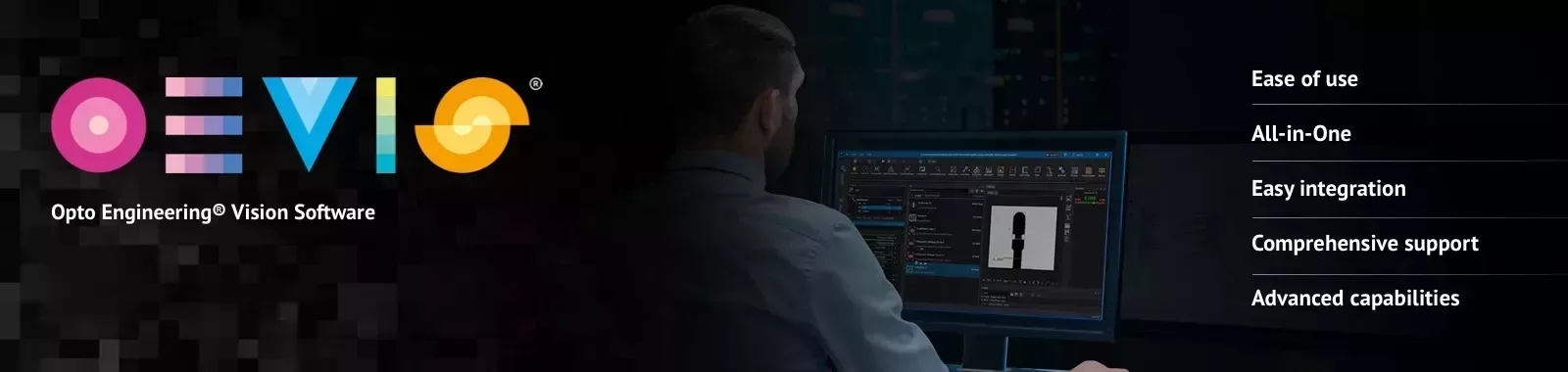
The most advanced vision hardware reaches its full potential only when it is supported by software capable of leveraging its performance. OEVIS is Opto Engineering's proprietary vision software, designed to simplify the integration and use of industrial vision systems in automation applications. In this article dedicated to OEVIS, we present the software architecture, the available toolsets, and the types of applications it can solve: from dimensional measurement to defect detection, from pattern recognition to code reading. The goal is not only to describe the technical features but to concretely show how OEVIS transforms a set of optical and electronic components into an operational automated inspection solution, reducing setup times and ensuring repeatability of results.
This article introduces OEVIS®, the all-in-one vision software for industrial automation developed by Opto Engineering, and provides an in-depth analysis of its architecture, features, and use cases. The discussion starts from a fundamental need that OEVIS addresses: providing a unified development and runtime environment with no need to write code. From there, it moves on to describe the individual machine vision toolsets and their practical applications in real-world industrial quality control contexts. It explores multi-camera acquisition modes, parallel processing logic, integration with industrial automation protocols, and licensing options. The text is intended for system integrators, automation operators, and technical managers evaluating industrial machine vision software solutions for production, packaging, or assembly lines.
Topics covered in this article
- What is OEVIS and who is it intended for?
- How is OEVIS's architecture structured?
- Which machine vision toolsets are available in OEVIS?
- In which automated inspection applications is OEVIS used?
- How does OEVIS integrate with industrial automation systems?
- How does the OEVIS licensing model work?
- What is the value of proprietary software within an integrated vision ecosystem?
What is OEVIS and who is it intended for
OEVIS® is the all-in-one vision software developed and distributed by Opto Engineering for industrial automation applications. It is an advanced environment for the rapid development of vision applications that requires no coding, making it accessible to a broad range of users without sacrificing the technical depth required for complex applications.
The software is designed specifically for three categories of users: system integrators who need to configure and install inspection machines at end customers' sites, industrial vision specialists who need a flexible and powerful environment to solve sophisticated applications, and automation engineers looking for a versatile and user-friendly tool to integrate into automation lines. This three-way focus is what sets OEVIS apart from generalist solutions: it is neither a tool intended exclusively for the basic user nor solely for the advanced programmer, but covers the entire range of intermediate needs through a single coherent interface.
OEVIS's positioning within the Opto Engineering portfolio is significant: the company is one of the few in the world capable of designing, manufacturing, marketing, and providing support for all the components of an industrial vision system: optics, cameras, illuminators, and software.
How OEVIS's architecture is structured
The heart of OEVIS's architecture is a visual programming environment that uses a graphical approach to build image processing flows. Unlike traditional environments that require code to be written, OEVIS allows users to automatically connect various machine vision and logic tools through a drag-and-drop interface, reducing development time and lowering the entry threshold for new users.
OEVIS's computational model with the multi-threading add-on is based on parallel multi-threading processing: algorithms and analysis cycles are executed simultaneously, allowing complex inspections with multiple cameras to be managed without introducing latency. Acquisition can take place synchronously or asynchronously from multiple devices connected at the same time, with direct access to all GenICam parameters of each connected camera.
A distinctive architectural element is the "development and runtime in a single license" philosophy: with a single OEVIS license, it is possible both to develop new applications and to run them in production. This means that line operators can directly and remotely modify the program installed at the factory — for example, to add vision controls, adapt to a variation in line speed, or manage a product format change — without having to resort to a separate development license.
Which machine vision toolsets are available in OEVIS
OEVIS's machine vision toolset covers the main categories of analysis required in automated inspection software and industrial quality control applications. Each tool is implemented with high-performance algorithms designed to operate reliably under the variable conditions of a real production line.
- Dimensional measurement: Edge detection with sub-pixel precision. Measurement of diameters, lengths, concentricity, radii, and angles on complex parts, including thread profile extraction.
- Distortion calibration: State-of-the-art algorithms for distortion correction that eliminate perspective effects and meet the requirements of telecentric lenses. Dedicated stand-alone tools for calibrating complex setups and optimizing measurement accuracy.
- Defect detection: Surface inspection to identify scratches, dents, impurities, and other anomalies. Support for complex inspections with multi-camera configurations.
- Code reading and OCR: Fast reading of Data Matrix ECC200, QR, PDF417, Aztec, and common barcodes. OCR with data augmentation for characters of any orientation and font.
- Pattern matching: Localization and recognition of geometric patterns and visual features for object positioning, presence verification, and alignment.
- Robot guidance: Precise hand-eye calibration algorithms for vision-guided robotics applications, such as pick-and-place. Accurate positioning of objects on the line thanks to the integration between visual recognition and automation systems.
- Machine learning: Classical machine learning models (MLP, SVM, KNN) and lustering functions (KMeans, DBSCAN) for complex image analysis tasks, such as distinguishing between different textures or grouping objects with irregular shapes.
- Deep learning inference via ONNX: Native ONNX support to load and deploy deep learning models trained in PyTorch or TensorFlow, combining AI inference and rule-based inspection within the same platform.
- Customizable HMI: Integrated graphical editor for designing customized front-end interfaces. Real-time visualization of results, data tables, and analysis previews.
- Debugging and monitoring: Event log, tracking of parameter values during execution, Modbus connection testing. Verification tools for individual analysis cycles.
OEVIS's measurement tools operate with sub-pixel precision: advanced algorithms detect feature edges using contour analysis techniques that make it possible to obtain reliable measurements even when image resolution is not sufficient to discriminate detail at the single-pixel level. This characteristic is decisive for high-repeatability measurement applications that would normally require high magnifications or other contact-based measurement methods.
In which automated inspection applications is OEVIS used
The industrial machine vision software OEVIS is used across a wide range of sectors and types of inspection. The versatility of its toolset makes it suitable for dimensional metrology applications, surface inspections, and both high-speed lines and semi-automatic testing stations.
In the pharmaceutical sector, OEVIS has been used to develop in-line inspection systems for verifying labels on high-speed plastic bottles, performing OCR to read the reference code, batch number, and traceability information, as well as verifying correct label positioning and detecting double-label conditions.
In the automotive sector, the software supports multi-configuration inspection systems: a backlight configuration for measuring injector nozzles and a front-light configuration for surface inspection and data matrix reading, with switching between the two modes managed within the same OEVIS program.
In the food and beverage sector, OEVIS is integrated, for example, into systems for measuring and inspecting bottles and preforms and for verifying container silhouettes. The software manages the acquisitions produced by industrial cameras, which require precise synchronization between acquisition trigger and strobe controller activation.
Additional application examples:
- Inspection of mechanical components to detect surface defects such as cracks, scratches, or pits down to 200 microns in size.
- Verification of cap and closure positioning on syringes and vials with 360° inspection using pericentric lenses.
- Quality control of electronic components with OCR reading on plastic substrates and surface analysis of integrated circuits.
- Inspection of microtiter plates in life science, where the precision of telecentric lenses is an essential requirement to avoid parallax effects.
How OEVIS integrates with industrial automation systems
Integration with industrial automation systems is one of the most carefully designed aspects of OEVIS's architecture. The vision software for automation supports a wide selection of communication standards and protocols, designed to ensure maximum compatibility with the control infrastructures already in place at production sites.
On the fieldbus protocol side, OEVIS natively supports Profinet, EtherCAT, and Ethernet/IP through Hilscher CIFX boards. On the software protocol side, OPC UA Client, Modbus TCP/RTU in both client and server modes, TCP/IP, WebSocket, HTTP, and MQTT Client are natively supported. Support for Advantech ADAM I/Os and the RS232/RS485 serial interface is also available.
For advanced integrations, OEVIS exposes a REST API that provides access to configuration data and inspection results from remote or local systems, leveraging the simplicity of implementation and efficiency of the JSON format. This opens the way to integrations with MES, ERP, or data analytics platforms for statistical quality monitoring in line with Industry 4.0.
How the OEVIS licensing model works
The OEVIS licensing model is structured to meet the different needs of those who develop vision systems professionally. Opto Engineering offers two types of license and an optional service contract.
The Base License is required to develop and run machine vision programs. It includes the core features of the software and, as already noted, combines development and runtime functions in a single license: the integrator who configures the system can leave the end customer the same license used to develop the application, without the need to purchase a separate runtime license.
The Additional License is optional and is designed to expand the functionality of the Base License. It includes multi-threading support, which enables the parallel execution of multiple processes, improving performance through the simultaneous processing of algorithms across multiple CPU cores. The add-on also enables synchronous multi-camera acquisitions, ideal for high-speed or coordinated inspections.
The OEVIS-EXT service contract guarantees access to specialized technical support and continuous software updates. Opto Engineering recommends annual renewal of the contract to remain aligned with the latest software versions and to benefit from priority support. A single OEVIS-EXT contract per customer covers all purchased OEVIS licenses, regardless of the number.
To facilitate software evaluation, Opto Engineering provides a free 30-day trial version that includes all the basic features and add-on modules, allowing a full evaluation prior to purchase.
What is the value of proprietary software within an integrated vision ecosystem
The choice to develop proprietary vision software reflects Opto Engineering's strategy of being THE MACHINE VISION COMPANY®: a complete partner for those who develop vision systems, responsible for the entire value chain, from optics to software.
OEVIS is designed to be compatible with all GenICam-compliant cameras, including ITALA® industrial cameras, ensuring maximum integration flexibility into existing or heterogeneous systems.
Thanks to native access to the GenICam configuration parameters of each device, settings such as exposure time, gain, strobe synchronization, and acquisition trigger can be managed directly from the OEVIS environment, with no need for additional middleware layers.
A valuable element is the continuity of technical support. Using OEVIS together with Opto Engineering's hardware components allows users to refer to a single point of contact for the entire system, both hardware and software. This approach simplifies support management, eliminating the fragmentation typical of systems composed of components from different suppliers, where diagnosing issues requires coordination among multiple parties. With a single point of reference, problem identification and resolution become faster, more efficient, and more consistent.
Another relevant aspect is the coordinated update between hardware and software: when Opto Engineering launches a new family of cameras or a new series of optics, OEVIS software support is developed in parallel, ensuring users a consistent upgrade path without unexpected incompatibilities.
In terms of resources, Opto Engineering supports the adoption of OEVIS with structured educational materials:
- in-depth technical documentation specific to OEVIS software
- BASICS section with the fundamentals of machine vision
- TECH NOTES section with technical instructions and practical tips
- TECH INSIGHTS section with video series on the fundamental principles of machine vision
- EXE TRAINING with materials related to training courses delivered directly by our in-house machine vision experts
OEVIS is the result of Opto Engineering's decision not to limit itself to hardware production but to complete the offering with vision software for industrial automation. Its no-code visual development environment, combined with a toolset covering dimensional measurement, defect detection, code reading, and pattern recognition, makes it a tool that meets the real needs of operators without requiring specialist programming skills.
The single development–runtime license philosophy, multi-user management with configurable permissions, support for the main industrial automation protocols, and native integration with the Opto Engineering hardware catalog make OEVIS a coherent choice for those building automated inspection systems and large-scale industrial quality control.